Windows · Measuring
How to measure a window for replacement
Measure the opening the new window will sit in, not the old window: three widths and three heights, the smallest of each, both diagonals and the depth. The fitting gap comes off after that, and it is the manufacturer's number for the way the window will be fixed: ask for it rather than guess it. Write all six measures down. If something does not fit later, they say why.
Six steps, ten minutes an opening
-
Decide what you are measuring
A replacement window is made to one of two sizes, and the supplier needs to know which. If the old frame comes out, the new window fills the opening in the wall, measured between the faces of the wall once the frame is gone. If the new window fits inside the old frame, or over it, the size is taken on that frame. The two give different numbers.
When the old frame is still in, measure between the faces of the wall where you can see them (lift the trim or the sealant at a corner if you have to) and write down which one you measured.
Only the glass is going? That is a different measurement, between the rebates of the frame: see how to measure an opening for glass.
-
Three widths, three heights, smallest wins
Width at the top, the middle and the bottom. Height at the left, the middle and the right. The smallest of each three is the one that counts: a frame made to the widest measurement goes in at one end and jams at the other.
Openings are rarely parallel. Render is thicker at one end, a lintel sags a little, a timber frame racks with the building.
Write all six down, not just the smallest.
-
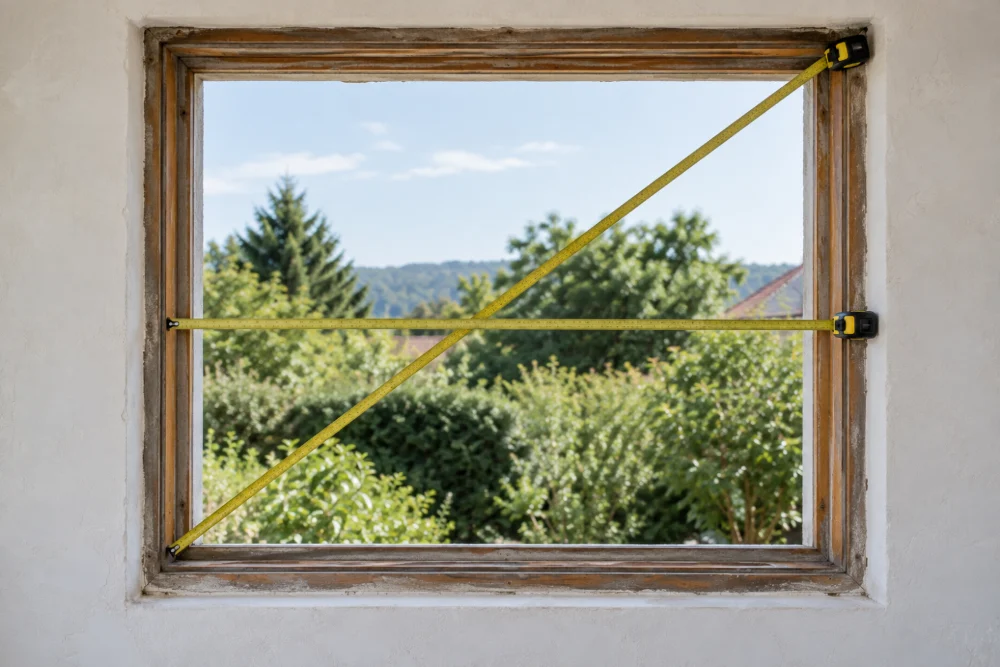
Both diagonals
Corner to corner, both ways. Equal diagonals mean a square opening. A window frame is a rectangle: in an opening whose diagonals differ, it has to be packed to square, and the gap it leaves is wider at two corners than at the other two.
Out of square is not a reason to stop. It is a reason to say so when you order, so that the fitter comes with the packing and the trims it needs.
This is the measurement nobody takes, and the one that explains most of the frames that do not sit right.
-
The depth and the sill
Measure the depth of the opening from the inside face of the wall to the outside face, and where the old frame sits in it. The new frame's depth has to fit, and it sets how much trim or plaster is needed inside.
At the bottom, look at what the frame stands on: a sill or cill, its slope, how far it sticks out, whether it stays or is replaced.
A photo of each opening, inside and outside, answers questions nobody thought to ask on site.
-
The fitting gap
The window is made smaller than the opening, so that it can be squared, packed, fixed and sealed. How much smaller depends on the window system and the way it is fixed, and it is the manufacturer's or the fitter's number. Ask for it before ordering; do not use somebody else's.
And say what your sizes are. If you send the opening and the supplier takes the gap off, good; if you take it off yourself and the supplier takes it off again, the window comes small.
Opening sizes or window sizes? Write it on the order, every time.
-
What else goes on the order
Which panes open and which way: the hinge side, and whether you mean seen from inside or from outside. Handle position. The glazing: double or triple, and safety glass where it is required near doors and low down. Colour inside and out, and anything the frame must carry, such as a vent or a shutter box.
One reference per opening (W01, W02…) on the measurements, the photos and the order, so nothing gets swapped.
Put it on the survey sheet
The free window and glass survey sheet takes the three widths, the three heights and the diagonals of each opening, picks the smallest, flags what is out of square, keeps the photos with arrows and dimensions in red, and prints the sheet to send with the order. It works in millimetres or in inches, and it stays in your browser.
Questions
Do you measure the old window or the opening?
The opening the new window will sit in. The old window may have been made to the wrong size, packed out or trimmed when it went in. If the new window fits inside the old frame, that frame is what you measure; say which one on the order.
Which of the three widths do you use?
The smallest. Openings are rarely parallel, and a frame made to the largest measurement will not go in. Keep all three on paper all the same: if something does not fit, they show why.
How much smaller than the opening is the window made?
By the fitting gap of the window system and fixing method, which the manufacturer or the fitter gives. It is not a universal number, so ask for it, and tell the supplier whether your sizes are opening sizes or already window sizes so the gap is not taken off twice.
What if the diagonals are not equal?
The opening is out of square. The frame can still go in, packed to square, but the gap is uneven. Write the difference on the order so the fitter comes ready for it.